
THE RULES
As the leader of a fishing community, your mission is to take care of your own people through fishing.
Every year (round) you can bid for new ships to increase your fleet, send them to a river or keep them in the harbor, fish, and receive the payout from your harvest.
Phases:
I) Auction
II) Rivers (deployment, fishing, and payout)
III) Harbor
Contents
• 6 pawns
• 65 coins
• 60 fish numbered pieces
• 2 fish stock markers
• year marker
• inspection coin
• deck of cards
• race board
Expansions
• 4 super harvest fish pieces
• 8 pirate attack fish pieces
Setup
| Each player starts with $20 in coins. |  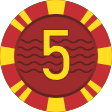 |
Ships
| Everyone places their pawn on the 20th space of the board and takes their ships (cards). The amount of ships depends on the number of players (see the table bellow). | 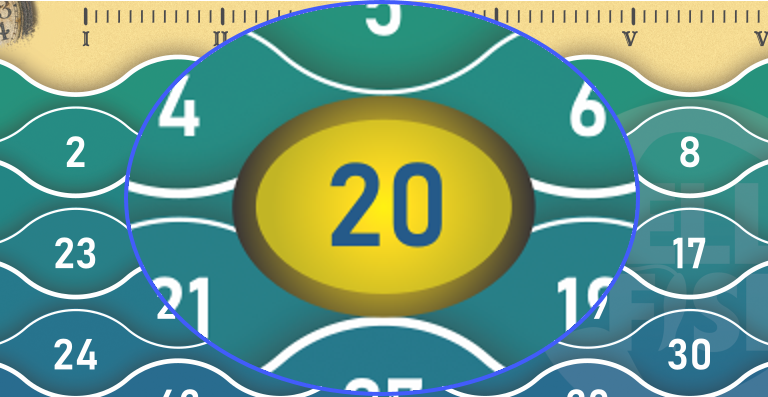 |
| Players | two | three | four | five | six |
| Ships per player | 5 | 3 | 2 | 2 | 2 |
Players need to pick one or two bluff cards to use during the deployment phase.
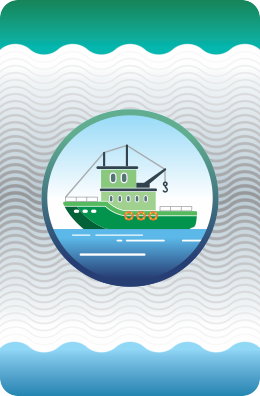 | 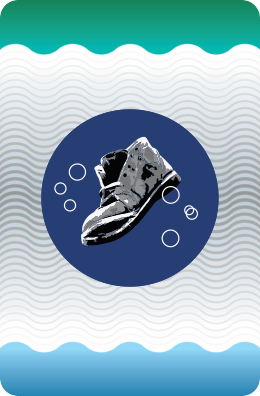 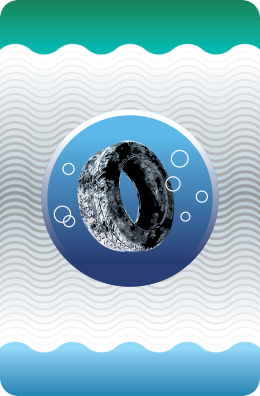 |
| Ship card | Bluff card |
Fish stock markers
The harvest in each river depends on the fish stock and the amount of ships fishing it. The ‘fish stock markers’ display how many ‘Fish Chips’ you will draw as the harvest per ship.
In the first year, the ‘fish stock markers’ start in these positions:
| Green River Blue River | 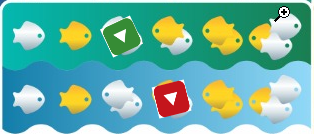 |
Green River : draw 2 silver ‘Fish Chips’
Blue River : draw 1 silver and 1 golden ‘Fish Chips’
Turn Progression
The game takes place in up to 10 years(rounds). We organize each round in three phases: I) Auction, II) Rivers, and III) Harbor.
I) Auction phase:
The year starts with two separate auctions at the shipyard for one new ship each. All players hold their bids secretly in their hands. When all players are ready, they reveal their bids simultaneously. The person with the highest bid pays and takes the ship.
The ship will belong to this person until the end of the game.
But you can trade it with another player at any time and at any price.
Pay by moving the pawn backward. Coins are only used to show your bid, not for paying.
II) Rivers
Deployment, fish, and payout must be completed first for Green River, and then repeated for the Blue River.
Deployment: every player decides on how many ships to send to the Green River. They place their cards face down on the table, and when everyone is ready, reveal the decisions. Remember to add some bluff cards to your ships eventually, so the other players won’t know how many ships you sent before revealing the decisions. Now, reveal the cards and count how many ships will fish in this river.
Fishing: before fishing set the new fish stock by moving forward (or backward) the ‘fish stock marker’ according to the amount of ships fishing in the river (see the table below).
| Ships | 0 to 3 | 4 or 5 | 6 to 8 | 9+ |
| Stock Marker Move | fwd 1 | no | back 1 | back 2 |
Now every player has to draw from raffle bag (or the table) the ‘Fish Chips’ showed by the ‘fish stock marker’ for the current river.
 |  |
| Silver fish chip | Golden fish chip |
Each ship you’ve deployed harvests as much fish as the sum of the ‘fish chip’ you drew.
Payout: fish sells for $1 each, but ships also have an annual cost of $10 per ship. Therefore, each ship receives the amount of fish caught minus 10. The player moves the pawn along the scoring track by that amount multiplied by the number of ships sent to this river (forward if the harvest is over 10 and backward if it is less). Now the next player does the same until all players finish fishing in the Green River. Only then the players will return the ‘Fish Chips’ to the table (or raffle bags) and start fishing in the Blue River.
| If you get to 50 on the board, take a special +50 card and start over 1 on the board. |  |
III) Harbor
All ships not deployed to the rivers remain at the harbor. They don’t fish, and their operational costs are $3 (3 spaces backward per ship in the harbor). Move your pawn backward, collect your boats, advance the calendar to the new year, make a toast and move on to the next auction (phase I).
Extinction Threat
—–
read only if one of the ‘fish stock markers’ is in the first or second position
(one silver or golden ‘fish chip’)
——
If any river in the previous round only got to one fish chip (golden or silver) then you are in danger, as the fish are facing an Extinction Threat. From now on, until the end of the game, before the auction, there will be an extra phase. To decrease the risk of fish extinction, the players have to create, negotiate and establish (or not) a quota for ships in each river. If there is no consensus, you can decide by vote on a majority basis; otherwise, the quota remains unchanged from the previous year.
Golden Rule
A quota can only be unequal between players if there is a consensus about it.
Finally, when a quota is agreed upon, there might be penalties for disobeying it.
In the River phase, after the Ship Deployment, any player that infringes the agreement has to flip the ‘inspection coin’ to determine if the inspection system will catch them or not. If the flip result is ‘detected’, the player will be fined. If so, ALL of her/his ships in this river return to the Harbor, paying for its operational cost ($3), and on top of that, a fine. The player draws a silver fish chip and pays a fine:
FINE = fish chip x ships sent OVER the limit
The first time the player is caught in a violation, the fine is just half of it.
Inspection coin flip
 |  |
| you got caught | you’re free to fish |
Game Conclusion and Victory
At the end of years 6 to 9, a draw of silver ‘Fish Chips’ determine if the game continues or not. If at least one fish chip drawn is six, then the game is over. The amount of silver chips to draw:
| End of year | 6 | 7 | 8 | 9 | 10 |
| Silver chips to draw | 2 | 5 | 8 | 11 | End |
Your final score is the sum of your board score to the +50 cards you got and your fleet total value.
The salvage value of each ship depends on the total number of fish in both rivers. See the table below, and consider the ‘fish stock markers’ and sum the values of the two rivers to get the salvage value of each ship.
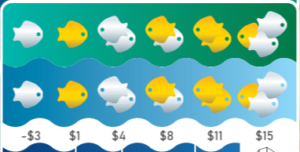
Sum the value of your fleet to your score on the board and your +50 cards.
 English
  Portuguese